Water is one of the most valuable resources in agriculture, and using it efficiently has become more important than ever. Whether you're managing a small vegetable farm, a large orchard, or commercial agricultural land, selecting the right Irrigation System can significantly improve crop yields while reducing water wastage and operating costs.
Today's farmers have access to a wide range of Agricultural Irrigation Systems, each designed to suit different crops, soil conditions, farm sizes, and water sources. However, choosing the wrong system can lead to uneven watering, higher energy consumption, poor crop growth, and unnecessary maintenance expenses.
The ideal irrigation solution isn't simply the most advanced or expensive one it's the one that matches your farm's unique requirements. Factors such as crop type, field layout, soil characteristics, water availability, and future expansion all influence the decision.
In this guide, you'll learn about the different types of irrigation systems, how they work, and the key factors to consider before investing in modern Farm Irrigation Solutions.
How Do You Choose the Best Irrigation System?
The best Farm Irrigation System depends on your crop type, soil conditions, water availability, field size, and budget. Drip Irrigation Systems are ideal for water-efficient irrigation of row crops and orchards, Sprinkler Irrigation Systems provide uniform coverage for many field crops, while Rain Gun Irrigation Systems are suitable for large open fields requiring long-distance water distribution. Choosing quality Irrigation Equipment from a trusted manufacturer ensures reliable performance and long-term value.
What Is an Irrigation System?
An Irrigation System is a network of pipes, valves, pumps, filters, and sprinklers or emitters that delivers water to crops in a controlled manner. Unlike traditional flooding methods, modern irrigation systems distribute water more efficiently, helping farmers improve yields while conserving valuable water resources.
A complete irrigation setup generally includes:
- Irrigation Pipeline
- Pumps
- Filters
- Irrigation Valves
- Controllers (for Automated Irrigation)
- Sprinklers or drip emitters
- Connectors and Irrigation Products
Together, these components ensure proper Water Distribution, maintain Pressure Regulation, and improve overall Irrigation Efficiency.
Why Choosing the Right Irrigation System Matters
Selecting the right irrigation method affects much more than water usage. It influences crop quality, operational costs, labour requirements, and long-term farm productivity.
The right irrigation system helps:
- Improve Agricultural Productivity
- Enhance Crop Water Management
- Reduce water wastage
- Lower labour requirements
- Improve fertilizer efficiency
- Support Water Conservation in Agriculture
- Increase irrigation uniformity
- Reduce operating costs
For today's farmers, investing in a Modern Irrigation System is an investment in sustainable and profitable farming.
Types of Agricultural Irrigation Systems
Different crops require different watering methods. Understanding each option makes it easier to choose the right solution.
Drip Irrigation System
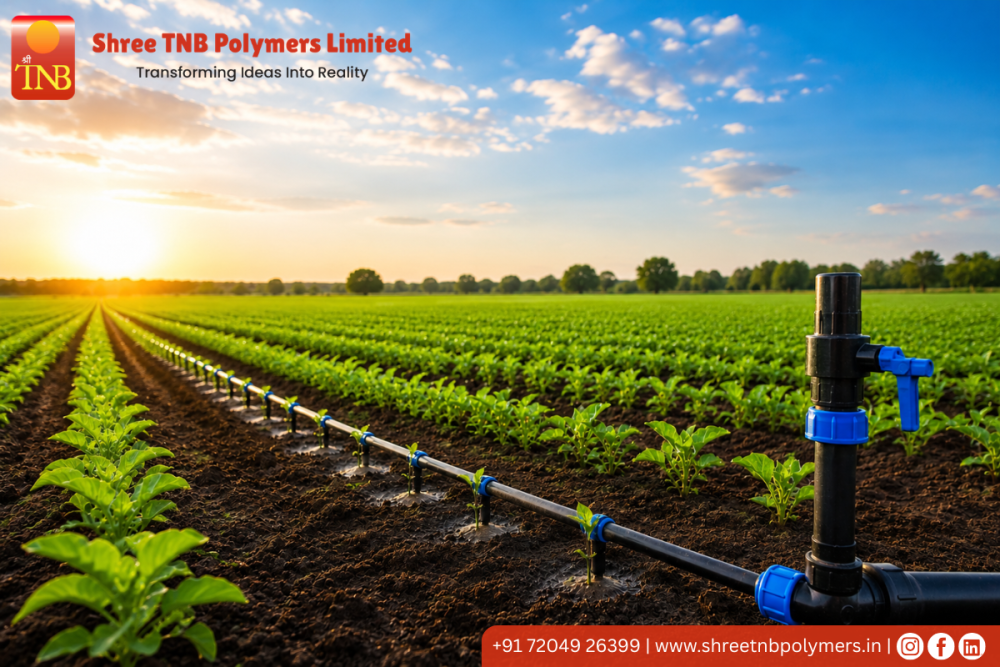
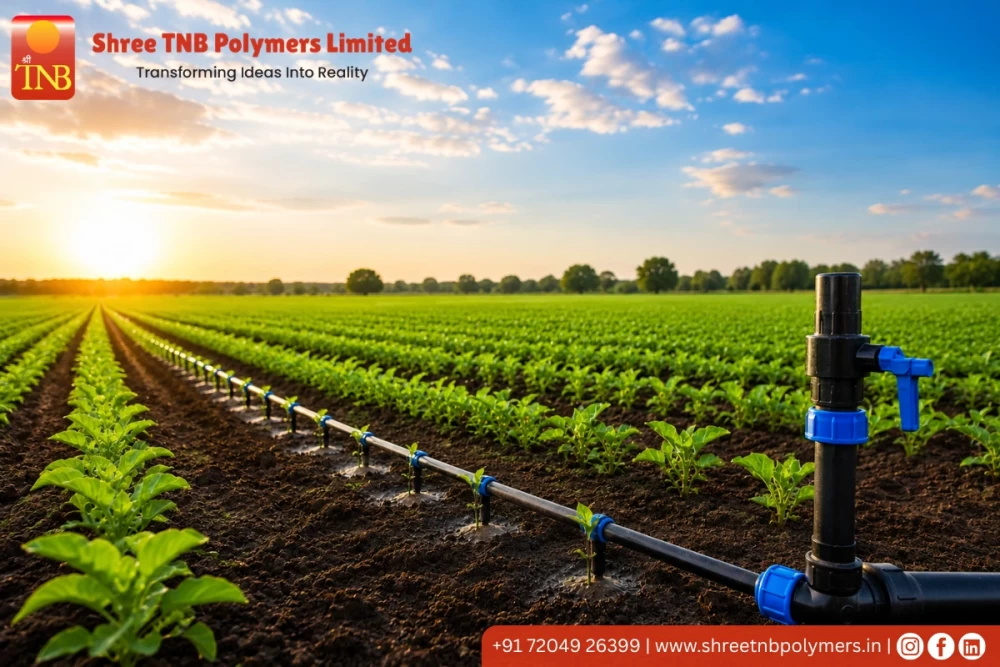
A Drip Irrigation System delivers water directly to the root zone through a network of emitters. This method minimizes evaporation and runoff, making it one of the most efficient irrigation techniques available.
Best suited for:
- Vegetables
- Fruit orchards
- Vineyards
- Sugarcane
- Cotton
- Greenhouses
Benefits
- Excellent Water-Saving Irrigation
- Improved fertilizer application
- Reduced weed growth
- Better soil moisture control
- High Irrigation Efficiency
For farms focused on Precision Irrigation, drip irrigation is often the preferred choice because it provides accurate water delivery while supporting better Soil Moisture Management.
Sprinkler Irrigation System
A Sprinkler Irrigation System distributes water through sprinklers that simulate natural rainfall. It is suitable for farms where uniform water application is required across larger areas.
Best suited for:
- Wheat
- Pulses
- Fodder crops
- Turf
- Vegetables
Benefits
- Uniform irrigation coverage
- Suitable for different soil types
- Easy installation
- Flexible operation
- Supports efficient Agricultural Water Management
Sprinkler systems are widely used because they provide reliable performance across different cropping conditions.
Rain Gun Irrigation System
A Rain Gun Irrigation System is designed for large agricultural fields requiring long-range water application. High-pressure rain guns can irrigate extensive areas quickly, making them suitable for commercial farming.
Best suited for:
- Sugarcane
- Groundnut
- Maize
- Pasture land
- Large field crops
Benefits
- Covers large areas efficiently
- Reduces irrigation time
- Suitable for uneven terrain
- Ideal for commercial farms
- Supports effective Water Management Solutions
Rain gun systems are often selected where speed and coverage are more important than localized irrigation.
Micro Irrigation
Micro Irrigation includes low-volume irrigation techniques designed to deliver water with maximum efficiency. It combines technologies such as drip irrigation and micro-sprinklers to reduce water consumption while improving crop performance.
Micro irrigation is particularly valuable in regions facing water shortages because it supports Sustainable Agriculture while improving irrigation precision.
Factors to Consider Before Choosing an Irrigation System
Every farm is different, which is why no single irrigation method works for everyone. Before investing in a system, evaluate the following factors carefully.
Crop Type
Different crops have different water requirements. Orchards and vegetable farms often benefit from drip irrigation, while cereals and fodder crops may perform well with sprinkler or rain gun systems.
Farm Size
The size and layout of your farm influence the type of irrigation equipment required. Larger farms may require multiple irrigation zones and higher-capacity systems, while smaller fields can often be managed with simpler solutions.
Water Availability
The amount of available water is one of the most important considerations. Farms with limited water resources should prioritize systems that maximize Water Conservation in Agriculture and reduce unnecessary losses.
Additional Factors to Consider Before Choosing an Irrigation System
Selecting the right Irrigation System goes beyond comparing different irrigation methods. To maximize efficiency and long-term performance, it's important to evaluate your farm's specific conditions.
Soil Type
The type of soil on your farm directly affects how water is absorbed and retained.
- Sandy soils drain quickly and often perform best with a Drip Irrigation System, which provides slow and controlled watering.
- Clay soils retain moisture for longer periods, making Sprinkler Irrigation Systems suitable in many situations.
- Loamy soils are compatible with most irrigation methods and offer excellent water retention.
Understanding your soil characteristics helps improve Soil Moisture Management and reduces unnecessary water loss.
Water Source and Availability
Your available water supply plays a significant role in choosing the right irrigation method.
Before installing any system, evaluate:
- Water availability throughout the year
- Water quality
- Pump capacity
- Distance between the water source and the farm
- Required operating pressure
Choosing an irrigation solution that matches your water source helps improve Agricultural Water Management and ensures consistent crop growth.
Budget and Long-Term Value
While cost is an important consideration, it should not be the only deciding factor.
Instead of focusing only on the initial investment, consider:
- Installation costs
- Energy consumption
- Maintenance requirements
- Expected service life
- Future expansion possibilities
A high-quality Farm Irrigation System may have a higher upfront cost but often delivers better long-term value through improved durability and lower maintenance.
Why Smart Irrigation Is the Future of Farming
Agriculture is becoming increasingly technology-driven. Modern farms are adopting Smart Irrigation to improve water management and increase productivity.
Unlike conventional systems, Automated Irrigation uses controllers, sensors, timers, and weather-based scheduling to deliver water only when required.
Some of the biggest advantages include:
- Improved Water Flow Control
- Better Pressure Regulation
- Reduced labour requirements
- Accurate irrigation scheduling
- Higher Irrigation Efficiency
- Better Crop Water Management
- Lower water consumption
For farmers looking to improve operational efficiency, smart irrigation offers a practical solution for sustainable farming.
The Importance of Quality Irrigation Equipment
No irrigation system performs well without reliable Agricultural Irrigation Equipment.
A complete irrigation setup typically includes:
- Irrigation Pipeline
- Filters
- Pumps
- Irrigation Valves
- Controllers
- Sprinklers
- Drippers
- Irrigation Accessories
Each component contributes to efficient Water Distribution, ensuring crops receive the right amount of water without unnecessary losses.
Using high-quality Irrigation Products also reduces maintenance and improves system reliability.
HDPE Pipes vs PVC Pipes for Irrigation
Choosing the right pipeline is just as important as selecting the irrigation method.
HDPE Pipes for Irrigation
HDPE Pipes for Irrigation are known for:
- Excellent flexibility
- High impact resistance
- Corrosion resistance
- Long service life
- Suitable for underground installations
They are commonly used in modern irrigation networks because they can withstand varying operating pressures and environmental conditions.
PVC Pipes for Irrigation
PVC Pipes for Irrigation are popular because they are:
- Lightweight
- Easy to install
- Cost-effective
- Suitable for low to medium-pressure applications
The right choice depends on your farm's irrigation design, operating pressure, and long-term requirements.
How to Choose the Right Irrigation System Manufacturer
Selecting a reliable Irrigation System Manufacturer is just as important as selecting the right irrigation method.
A trusted manufacturer provides products designed for durability, efficiency, and long-term performance.
When evaluating manufacturers, consider:
- Industry experience
- Product quality
- Manufacturing standards
- Complete range of irrigation products
- Technical support
- Product warranty
- After-sales service
Working with an experienced manufacturer ensures better system compatibility and dependable performance.
Common Mistakes Farmers Should Avoid
Many farmers invest in irrigation systems without fully evaluating their farm's requirements.
Avoid these common mistakes:
- Choosing the cheapest system instead of the most suitable one.
- Ignoring soil type and water availability.
- Installing undersized or oversized irrigation equipment.
- Using poor-quality pipelines and accessories.
- Neglecting regular maintenance.
- Not planning for future farm expansion.
- Purchasing from unreliable suppliers.
Careful planning helps improve irrigation efficiency while reducing maintenance costs.
Conclusion
Choosing the best Irrigation System is one of the most important decisions a farmer can make. The right solution improves crop health, increases Agricultural Productivity, conserves water, and reduces operating costs.
Whether you select a Drip Irrigation System, Sprinkler Irrigation System, Rain Gun Irrigation System, or another Modern Irrigation System, your decision should be based on crop requirements, soil conditions, water availability, and long-term farm goals.
Equally important is investing in quality Irrigation Equipment, Irrigation Products, and working with a trusted Irrigation System Manufacturer. A well-designed irrigation system not only supports Water Conservation in Agriculture but also helps build a more productive, profitable, and sustainable farming operation.
Gallery